A Bike Helmet in an Accident? Analyzing Life-or-Death Moments in 3 Types of Real Cycling Accidents
Introduction: The Importance of Helmets Cannot Be Ignored.
Bike helmets have long been considered one of the most important safety equipment for cyclists.
Cycling accidents are frequent, especially on urban and mountain roads, where accidents can happen at any time. According to statistics from the World Health Organization and various national traffic safety authorities, head injuries are a leading cause of death and serious injury among cyclists.
Helmets not only absorb impact and reduce head damage in accidents, but they can also be a matter of life and death in critical moments. Therefore, understanding the role of helmets in different types of accidents is of practical significance for every cyclist.
Accidents often happen in the blink of an eye. When faced with brake failure, vehicle collisions, or road obstacles, the impact on a cyclist’s head can reach tens to hundreds of times the force of gravity.
Scientific experiments have shown that a properly fitted bike helmet can significantly reduce the probability of head injuries and minimize long-term consequences from minor impacts. Helmets are an irreplaceable safety guarantee for family rides, urban commutes, and competitive cycling.
This article will analyze the crucial role of helmets in accidents through three real-world cycling accident cases and delve into the mechanisms of these accidents and the principles of protection they provide.
I. Urban Traffic Collisions: Low-Speed but Deadly Risks
In urban areas, cyclists share roads with motor vehicles, pedestrians, and other bicycles, creating a complex traffic environment. Even at low speeds, a single collision can cause serious head injuries.
Case data shows that in urban collisions at speeds below 20 km/h, cyclists not wearing helmets are approximately twice as likely to suffer traumatic brain injury as those wearing helmets.
An adult cyclist was struck by a car making a right turn at a city intersection while riding at only 15 kilometers per hour. He was not wearing a helmet at the time, and his head struck the road directly, resulting in a skull fracture, concussion, and loss of consciousness.
If he had been wearing a properly fitted helmet, the impact force would have first acted on the EPS foam energy-absorbing layer, and the pressure would have been dispersed through the outer shell, significantly reducing the force on the head. Accident statistics show that even with a significant difference in size between the vehicle and the cyclist, a helmet can still reduce the rate of serious injury by 40% to 60%.
Low-speed collisions on city roads are dangerous because the cyclist’s head is directly exposed and lacks protection. Helmets not only protect the skull but also prevent head abrasions, soft tissue contusions, and facial injuries.
In low-speed accidents, the cushioning and friction-dispersing properties of a helmet are sufficient to prevent minor impacts from escalating into serious injuries. Therefore, even for short commutes and slow riding, wearing a bike helmet is essential.

II. Cycling Accidents in Mountainous or Downhill Areas: The Life-or-Death Moment of High-Speed Impact.
Compared to city cycling, mountain roads or downhill cycling present the dual challenges of higher speeds and more complex terrain. Riders often exceed 40 kilometers per hour when going downhill or making sharp turns; a fall results in a direct impact to the ground, rocks, or curbs with tremendous force. Such accidents often determine life or death in an instant.
A mountain biker lost control on a downhill curve, his head striking a rock directly without a helmet, resulting in severe head injury and unconsciousness.
Had he been wearing a proper helmet, the EPS foam could compress in milliseconds, absorbing hundreds of joules of impact energy, significantly reducing the force on the brain. Simultaneously, the outer shell disperses the impact, spreading the force over a larger area and preventing excessive localized pressure that could lead to skull penetration or brain contusion.
High-speed cycling accidents highlight the crucial role of bike helmets in protecting against high-energy impacts. Compared to low-speed urban collisions, high-speed downhill accidents involve more concentrated and directional impacts.
Therefore, the streamlined shell and multiple ventilation points in helmet design not only provide aerodynamic advantages but also disperse impact force upon impact, making the helmet’s safety performance even more critical. Furthermore, wearing a helmet can mitigate secondary injuries from impacts, such as rolling after a fall or striking rocks or tree trunks; the cushioning provided by the helmet significantly reduces the mortality rate.
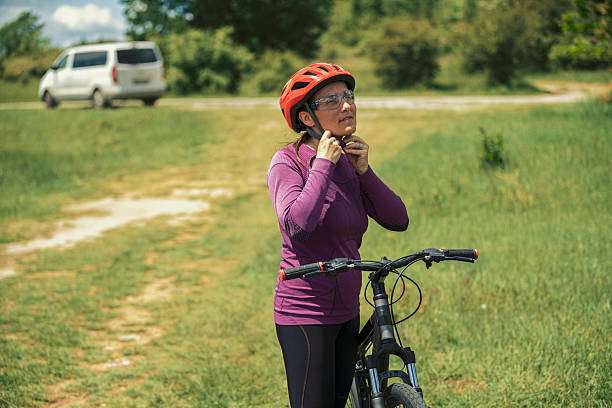
III. Bicycle Crashes and Obstacle Collisions: Unforeseen Injuries from Accidents
During cycling, spontaneous falls or collisions with road obstacles are among the most common types of accidents. Even at low speeds, direct head contact with the ground or handlebars can cause serious injury.
Studies show that about 20% of minor falls without a helmet result in head contusions or facial fractures, while wearing a helmet can effectively reduce this rate.
A child slipped on wet grass while riding in a park, and his head struck a rock directly, resulting in unconsciousness and a minor skull fracture.
Wearing a helmet would have allowed the energy-absorbing combination of EPS foam and the outer shell to absorb approximately 70% of the impact, turning a minor collision into a safe transition and preventing serious injury. Children’s bike helmets are typically designed with additional temporal protection to cushion the impact in the side of the head.
Single-vehicle crashes highlight the protective role of helmets in multi-directional impacts. Unlike the unidirectional pressure of a vehicle collision, a crash or obstacle collision can result in oblique head impacts, rotational impacts, or multiple impacts.
Modern helmets are designed with rotational force absorption technologies (such as the MIPS system), which reduce the force on brain tissue through the relative sliding of internal linings, thereby further improving safety in accidents.
IV. The Scientific Principles of the Key Role of Helmets
In all cycling accidents, the core protective principle of a bike helmet mainly relies on EPS foam for energy absorption, the outer shell for impact dispersion, and an adjustable fit structure.
- EPS foam absorbs impact energy through compression, converting high impact force into tolerable low pressure.
- The outer shell disperses local pressure through rigidity, preventing impact from concentrating at one point and causing fractures.
- The adjustable fit structure ensures the helmet fits snugly to the head, preventing slippage or displacement during a collision.
Accident studies have shown that helmets can effectively protect the head even in impacts exceeding 50G.
A bike helmet’s protection extends beyond the top of the head, covering the forehead, temples, and back of the head, minimizing brain contusions and skull fractures.
Scientific experiments and accident cases both demonstrate that riders wearing helmets have significantly higher survival rates and greater injury reduction in severe impacts than those not wearing them.

V. Verification through Data and Practice
According to statistics from international cycling safety organizations:
- Cyclists wearing helmets have a 40% to 50% lower fatality rate.
- Cyclists wearing helmets have a 60% lower rate of serious injury in accidents.
This percentage is even higher among children. Data from urban traffic, mountain cycling, and park activities all show that helmets are the only equipment that can provide reliable protection instantly.
On-site observations at the accident scene demonstrate that bike helmets are remarkably effective in protecting the rider’s head structure and reducing skull fractures and brain tissue damage.
Even in minor collisions, the helmet’s cushioning function can prevent abrasions, bruises, and short-term concussions. In the long term, it also helps reduce long-term effects such as chronic headaches and memory loss.
Both practical experience and experimental data prove that the role of a helmet in life-or-death moments is irreplaceable.
VI. Best Practices for Wearing a Helmet
To ensure maximum protection in the event of an accident, cyclists should choose the correct bike helmet and wear it properly.
- The helmet size should match the head circumference.
- When worn, the top of the helmet should be about two finger widths away from the eyebrows.
- Velcro or buckles should be securely fastened to prevent the helmet from tilting forward, slipping backward, or rotating.
- Regularly inspect the helmet shell and EPS foam for cracks, aging, or deformation to ensure the helmet is in optimal protective condition for every ride.
Different types of cycling require different bike helmets:
- Lightweight, breathable helmets are suitable for urban commuting.
- Professional helmets with extra protection for the temples and back of the head are needed for mountain biking or downhill riding.
- Children’s bike helmets should be equipped with adjustable padding and safety certification marks to ensure a good fit for children’s heads and provide multi-directional protection.
Conclusion: A Bike Helmet is a Decisive Factor in Life-or-Death Moments.
Through the analysis of three case studies—urban traffic collisions, high-speed cycling accidents in mountainous areas, and bicycle crashes involving obstacles—the crucial role of bike helmets in cycling accidents cannot be ignored.
They not only absorb impact and distribute pressure, but also prevent secondary injuries, buying cyclists time to survive and reducing harm.
Accident data and scientific experiments fully demonstrate that bike helmets are the most effective and direct protective equipment for cycling safety.
Whether you’re an adult or a child, whether you’re commuting in the city or engaging in extreme cycling, wearing a bike helmet is essential for protecting your life and reducing the risk of injury. A helmet is not just a piece of equipment; it’s a responsibility and a lifestyle. Understanding the crucial role of helmets in accidents is a safety awareness that every cyclist should have.
FAQ
Question 1: Can wearing a bike helmet completely prevent brain injury?
Helmets cannot guarantee complete prevention of brain damage, but they can significantly reduce the probability and severity of injury, making them one of the most effective protective measures for cycling.
Question 2: Does a bike helmet provide the same level of protection in different types of accidents?
Bike helmets offer protection against low-speed collisions, high-speed downhill driving, and self-inflicted obstacle falls. However, in high-speed impacts, choosing a professional helmet and wearing it correctly are more crucial.
Question 3: A bike helmet needs to be replaced after an accident?
Yes, even if there is no obvious damage to the exterior, the EPS foam may have suffered microscopic damage. It is recommended to replace the helmet promptly after an accident to ensure safety on the next ride.
Related Posts
Bike helmets evolved? Five stages showcasing the disruptive transformation of protective systems.
-
Posted by
 Nichole Kihn
Bike helmets? 4 safety considerations for parent-child cycling.
-
Posted by
Nichole Kihn
in bike helmets ? A 4-layer energy-absorbing structure analyzes the core of its safety.
-
Posted by
Nichole Kihn